Start here
EDS-201IntermediateFree
Experiment Design and Statistics for Plant Science
Part of Plant Science FoundationsMolecular and Genomic Plant ScienceThe Complete Plant Science Library
How to design an experiment that can answer its question and analyse it honestly: units and pseudoreplication, randomisation and blocking, sample size and power, factorial designs, describing data, confidence intervals, t-tests, ANOVA and regression, with plant culture and greenhouse examples worked through.
- 6 modules
- 22 lessons
- 6 quizzes · 65 questions
- about 2.4 hours of study
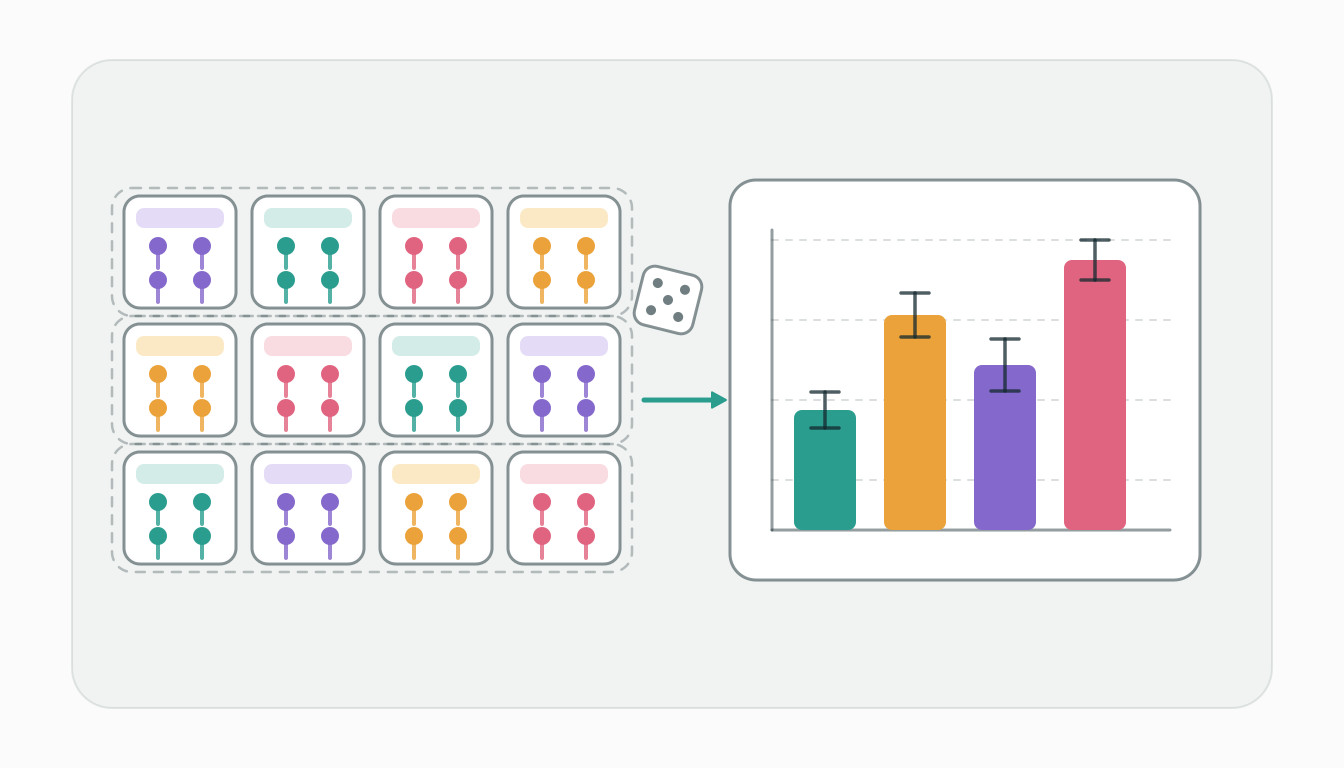
22 lessons
FreeFree. Create an account to open the lessons, save progress and earn the certificate.
- Free lessons
free account to read - Self-paced
about 2.4 hours - 22 diagrams
drawn for this course - 65 quiz questions
explained answers - Certificate
verifiable online
6modules
22lessons
22diagrams
65quiz questions
Outcomes
What you will be able to do
- 1Identify the experimental unit and avoid pseudoreplication
- 2Use randomisation, replication, blocking and controls to protect a comparison
- 3Calculate the replication needed for a given effect size and variability
- 4Design and interpret a factorial experiment with interactions
- 5Summarise and plot data honestly, and say what error bars mean
- 6Compute and interpret confidence intervals, t-tests, ANOVA and multiple comparisons
- 7Fit and interpret a regression and a dose-response curve
- 8Plan data management and reporting so an experiment can be reproduced
Audience
This course is built for you if…
1
Researchers and students who run experiments with plants, cultures, greenhouses or growth rooms
2
Technicians who must design media, light or fertiliser trials
3
Quality staff who analyse batch and survival data
4
Anyone who has to judge whether a result is real
Curriculum
Your learning journey
6 modules. Read each lesson, work the examples, then take the module quiz.
Module 1
Asking a Good Question
Hypotheses, experimental units and pseudoreplication, controls and confounding, and the difference between accuracy and precision.
Module 2
Principles of Design
Randomisation, replication and sample size, blocking, and factorial designs.
Module 3
Describing Data
Types of data and summaries, distributions and transformations, honest plots and error bars, and handling outliers and missing values.
Module 4
Inference
Confidence intervals and the t-test, what p-values mean and the two kinds of error, ANOVA and multiple comparisons, and tests for proportions.
Module 5
Relationships and Reproducibility
Linear regression, dose-response curves, analysing blocked designs, and keeping experiments reproducible.
Module 6
Final Assessment
A summary of the course and a comprehensive final quiz.
- 6.1 Course summary and next steps
- ?Final Assessment: Experiment Design and Statistics15 questions · pass 70%
Included
What you get, free
01
A diagram and a generated illustration in every lesson
02
Worked examples: sample size, t-test with confidence interval, ANOVA table, Tukey comparisons, 2 × 2 factorial interaction, and regression
03
Quizzes with an explanation for every answer
04
Certificate of completion with a public verification page
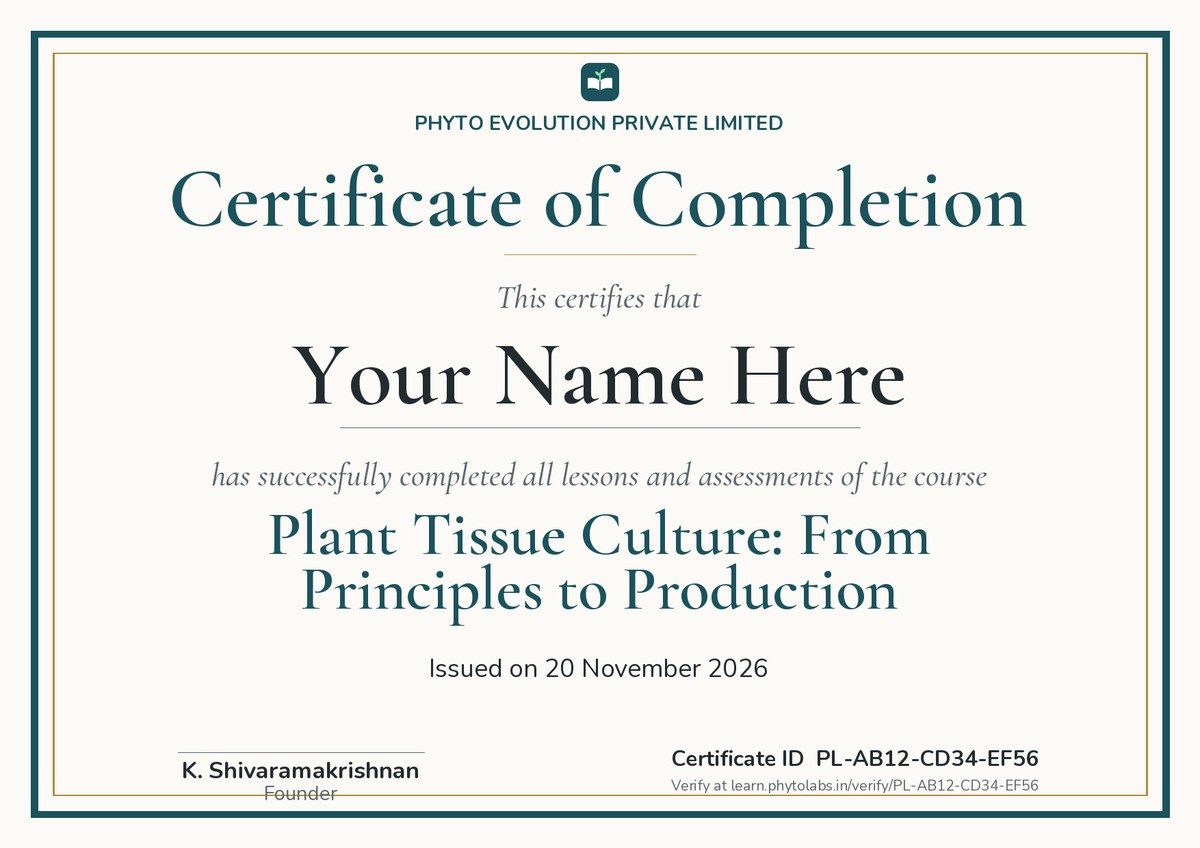
Certificate
Earn a certificate anyone can verify
Complete every lesson and pass every quiz in Experiment Design and Statistics for Plant Science. Your certificate has a unique ID and a public verification page.
Start learning free FAQ
Frequently asked questions
Do I need to know mathematics?
Only arithmetic and a willingness to read formulas. Every calculation is worked through with real numbers, and the ideas come before the algebra.
Which software does it use?
None is required. The calculations are shown by hand so you can see what a program does, and any statistics package can then be used.
Is it about a particular crop?
No. Examples come from plant tissue culture, greenhouse and growth-room work, but the principles apply to any experiment.
Is it free?
Yes. Lessons, quizzes and the certificate are free; a free account opens them and saves progress.
How do I get the certificate?
Finish every lesson and pass every module quiz (70% or more, unlimited retries).
Start EDS-201 today
Free, self-paced, with quizzes, calculators and a certificate.