Start here
Start Here
What plant breeding is as a science, how the course is organised, and the notation used throughout.
Part of Molecular and Genomic Plant SciencePlant Breeding and GermplasmThe Complete Plant Science Library
The genetics behind plant breeding and the methods built on it: Mendelian ratios and chi-square, linkage, Hardy-Weinberg, quantitative traits and heritability, mating systems and inbreeding, response to selection and gain per year, pure-line and backcross methods, heterosis and combining ability, recurrent selection, polyploidy, wide crosses, mutation and editing, markers and genomic selection, field trials and variety release, with every calculation worked through.
7 modules. Read each lesson, work the examples, then take the module quiz.
What plant breeding is as a science, how the course is organised, and the notation used throughout.
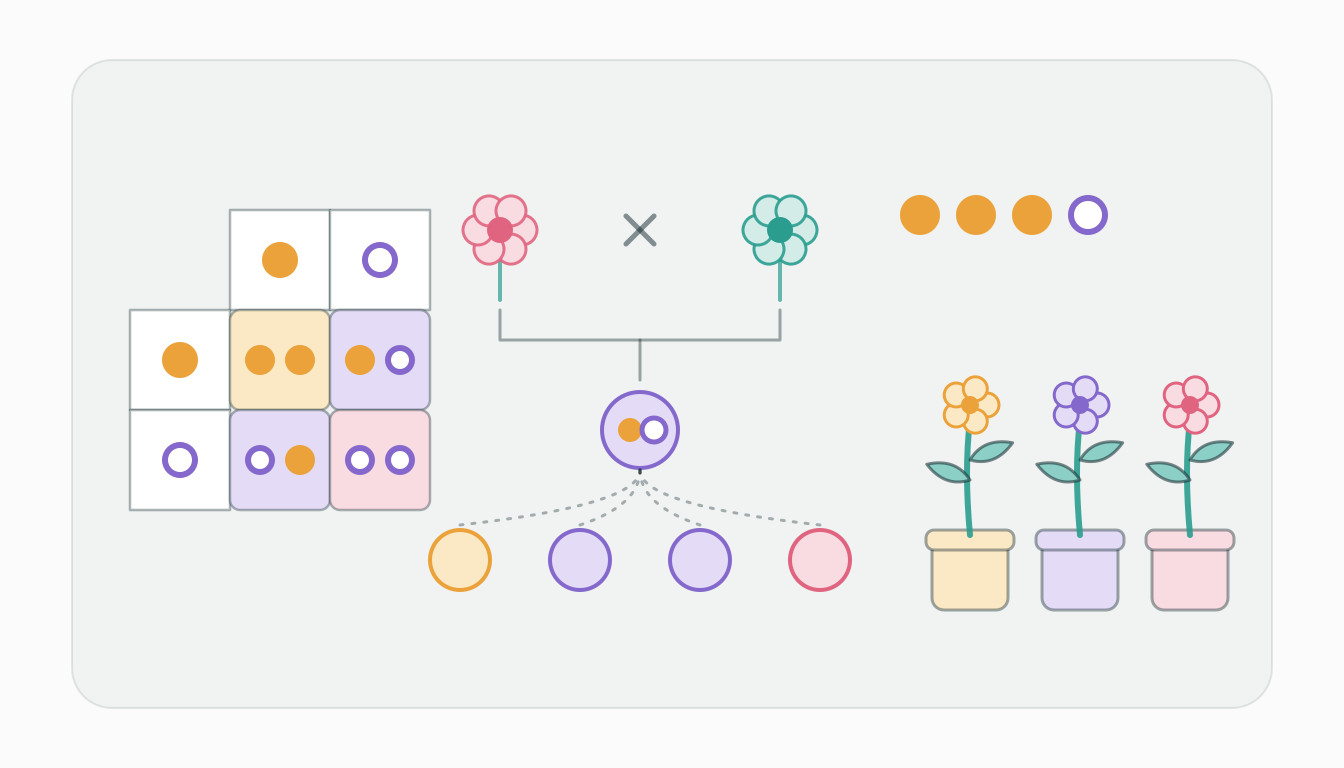
Mendel's ratios and the probability behind them, testing observed counts with chi-square, linkage and recombination, and the ratios produced when genes interact.
Allele and genotype frequencies in a random-mating population, polygenic traits, the partition of variance and the meaning and estimation of heritability.
Self and cross pollination and how crosses are controlled, inbreeding and effective population size, the breeder's equation R = h²S and genetic gain per year.
Pedigree, bulk, single-seed descent and doubled-haploid methods, backcrossing and genome recovery, heterosis, and combining ability for hybrid breeding.
Recurrent selection and synthetic varieties, polyploidy, wide crosses and chromosome doubling, and mutation, somaclonal variation and genome editing as sources of new alleles.
Molecular markers and how linkage makes them useful, QTL, marker-assisted and genomic selection, field trial design and genotype by environment interaction, and the concepts of variety testing, release and seed multiplication.
A summary of the course, a worked paper plan for a breeding scheme, and a comprehensive final quiz.
A diagram in every lesson
Worked examples: chi-square, linkage, Hardy-Weinberg, heritability, response to selection, gain per year, backcross genome recovery, heterosis and combining ability
Quizzes with an explanation for every answer and a 25-question final assessment
Certificate of completion with a public verification page
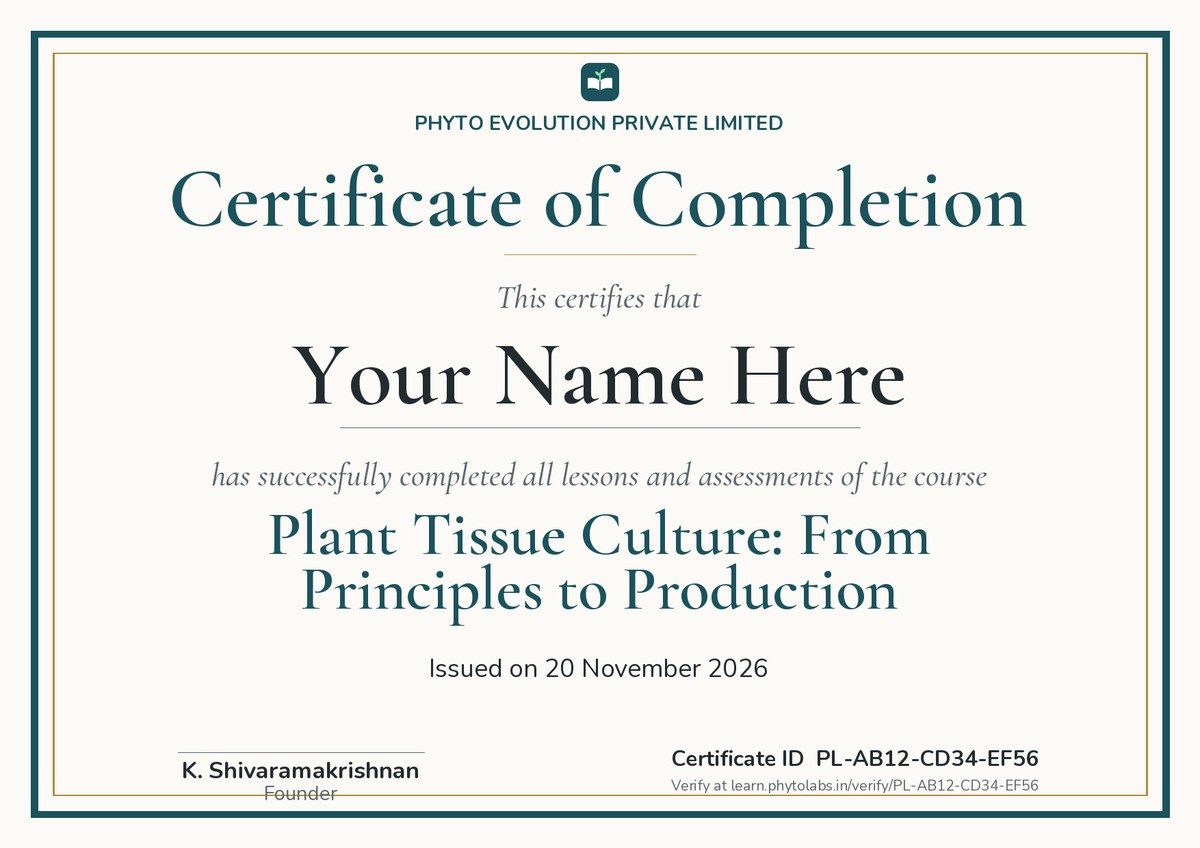
Complete every lesson and pass every quiz in Plant Genetics and Breeding Methods. Your certificate has a unique ID and a public verification page.
Start learning freeOnly arithmetic and basic ideas, which are recapped. Every calculation is worked step by step; EDS-201 goes deeper into experiment design.
No. Examples use peas, wheat, maize, rice and others for illustration; the principles apply to any crop.
It explains the science and notes that rules differ by country. It is not legal advice: check the current requirements of your own authority.
Yes. Lessons, quizzes and the certificate are free; a free account opens them and saves progress.
Finish every lesson and pass every quiz (70% or more, unlimited retries).
Free, self-paced, with quizzes, calculators and a certificate.