Module 1
Water in the Plant and the Substrate
How water moves from substrate to air along a potential gradient, what water potential and its components mean, how a growing medium holds and releases water, and why deficit and excess both hurt.
Part of Protected Cultivation PathwayThe Complete Plant Science Library
Water as a physical and chemical system for plant production: water potential and the soil-plant-atmosphere continuum, evapotranspiration and crop demand, irrigation methods and uniformity, reading a water analysis (EC, pH, alkalinity, hardness, SAR, specific ions), salinity and leaching, scheduling with substrate moisture and sensors, and the principles of water treatment and recycling. Every method is worked through with real numbers.
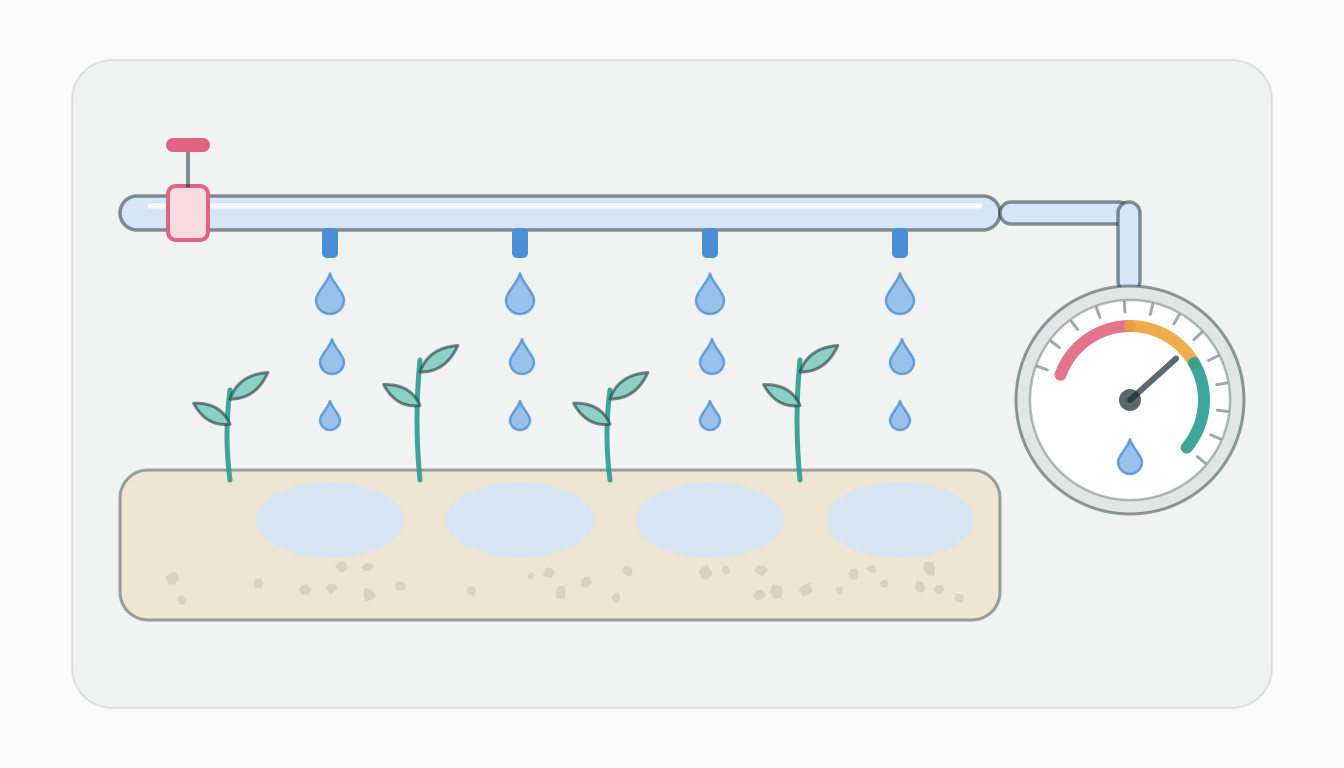
8 modules. Read each lesson, work the examples, then take the module quiz.
How water moves from substrate to air along a potential gradient, what water potential and its components mean, how a growing medium holds and releases water, and why deficit and excess both hurt.
How radiation and the vapour pressure deficit drive evaporation, how reference evapotranspiration is calculated, and how crop coefficients turn it into the volume a real crop uses.
How water reaches the crop by different methods, how to measure and interpret uniformity, and how pressure and emitter characteristics decide whether every plant gets the intended volume.
Units and charge balance, electrical conductivity and its link to osmotic potential, pH, alkalinity and hardness with acid-neutralisation arithmetic, and the specific ions that cause trouble.
How salts injure plants through osmotic and ionic effects, how crop tolerance is described, how much extra water is needed to leach salts, and how sodium affects infiltration.
The root-zone water balance, how moisture is measured by weight, dielectric and tension methods, and how models, sensors and drainage checks combine into a schedule.
What filtration and membranes remove and the mass balance of reverse osmosis, how ion exchange and oxidation change the chemistry, and the principles of disinfection, recirculation and rainwater use.
A worked water audit that uses every module in turn, followed by a comprehensive final quiz.
A diagram in every lesson, with the numbers plotted from the formulas in the text
Worked examples: water potential, vapour pressure deficit, Penman-Monteith, crop use, distribution uniformity, charge balance, acid neutralisation, SAR, leaching requirement, water balance, pore-water EC, reverse osmosis and bleed-off
Quizzes with an explanation for every answer
Certificate of completion with a public verification page
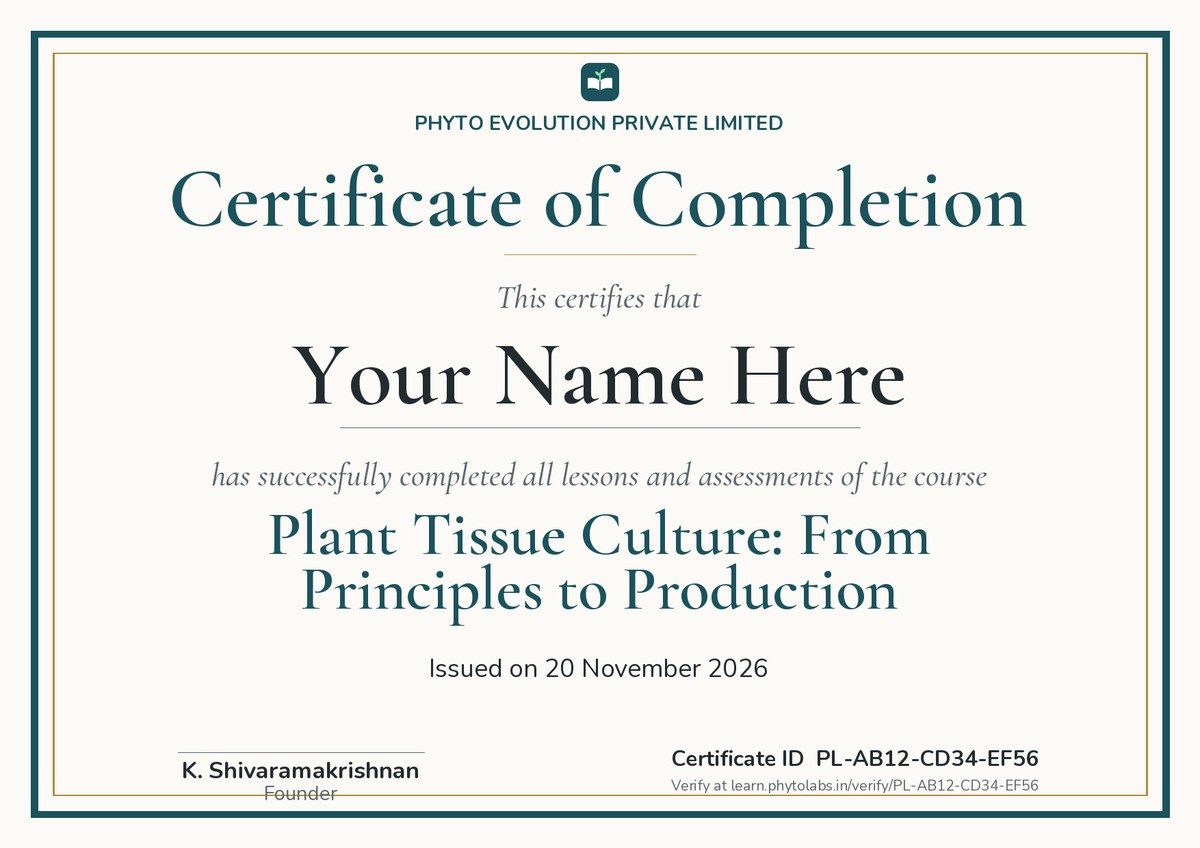
Complete every lesson and pass every quiz in Water Quality and Irrigation Science. Your certificate has a unique ID and a public verification page.
Start learning freeIt covers the science that design relies on (demand, uniformity, hydraulics, leaching, treatment principles), with worked calculations. It does not give equipment specifications or recommend brands.
Arithmetic and basic chemistry. GH-101 and PNM-201 are useful companions but not required.
Every worked example is calculated step by step and rechecked. Some inputs are stated assumptions (for example crop coefficients, a feed EC, or illustrative substrate retention values) and are flagged as such: validate them on your own material.
No. The course teaches the arithmetic and principles. Chemical use, handling and discharge depend on local regulations and safety rules, which you must check.
Yes. Lessons, quizzes and the certificate are free; a free account opens them and saves progress.
Finish every lesson and pass every module quiz and the final assessment (70% or more, unlimited retries).
Free, self-paced, with quizzes, calculators and a certificate.