Start here
Start Here
How the course works, its scope and the golden rule: check the current rules of your own country.
Part of Plant Health and BiosecurityThe Complete Plant Science Library
Why plant movement is regulated and how it works: how pests travel with trade, the international framework (IPPC, ISPMs, the SPS Agreement), pest risk analysis, inspection sampling, phytosanitary certificates, quarantine and containment. Principles and science only; always check your country's current rules.
5 modules. Read each lesson, work the examples, then take the module quiz.
How the course works, its scope and the golden rule: check the current rules of your own country.
How pests travel with trade, the international framework, quarantine pests and pest risk analysis.
Which pathways carry the most risk, how the probability of entry is built from a chain of events, how consignments are sampled, and how measures are combined to reduce risk.
What phytosanitary certificates, import permits, border inspection, post-entry quarantine and non-compliance procedures do, as principles.
Principles of quarantine facility design and operation, what is special about tissue culture, seed and germplasm, and the records that make traceability possible.
A summary of the course and a comprehensive final quiz.
A diagram, a worked example and a quick check in every lesson
Worked examples: entry probability chains, systems approach, inspection sample sizes with finite populations, and detection limits
Quizzes with an explanation for every answer
Certificate of completion with a public verification page
References to verified sources in every lesson
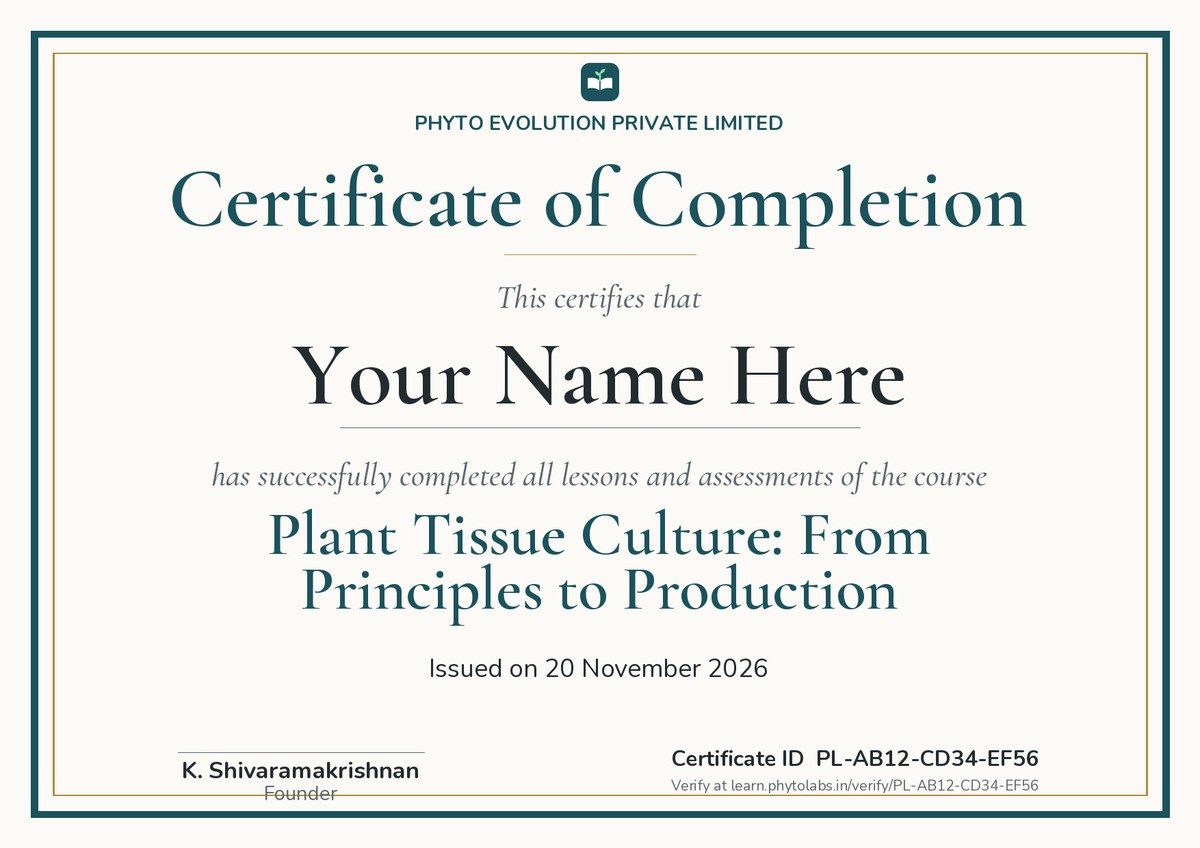
Complete every lesson and pass every quiz in Plant Imports and Phytosanitary Principles. Your certificate has a unique ID and a public verification page.
Start learning freeNo. Requirements differ between countries, crops and pests, and they change. This course explains the principles and the science. For any real import you must check the current requirements of your national plant protection organisation before doing anything.
No. It is an educational course on principles. Follow the instructions of the competent authority.
No. It covers plant health science and regulatory principles only.
Yes. Lessons, quizzes and the certificate are free; a free account opens them and saves progress.
Finish every lesson and pass every module quiz (70% or more, unlimited retries).
Free, self-paced, with quizzes, calculators and a certificate.