Start here
Start Here
What this course covers, how to study it, and the habits that keep a genomic result honest.
Part of Molecular and Genomic Plant SciencePlant Breeding and GermplasmThe Complete Plant Science Library
How plant genomes are built and why they are hard to sequence: size, repeats, polyploidy and organelles; sequencing technologies, coverage and read quality; assembly, N50 and BUSCO; alignment, variant calling, filtering and population statistics; annotation, synteny and phylogenetics; RNA-seq normalisation, TPM and false discovery rate; and the habits that make an analysis reproducible. Every calculation is worked by hand with real numbers.
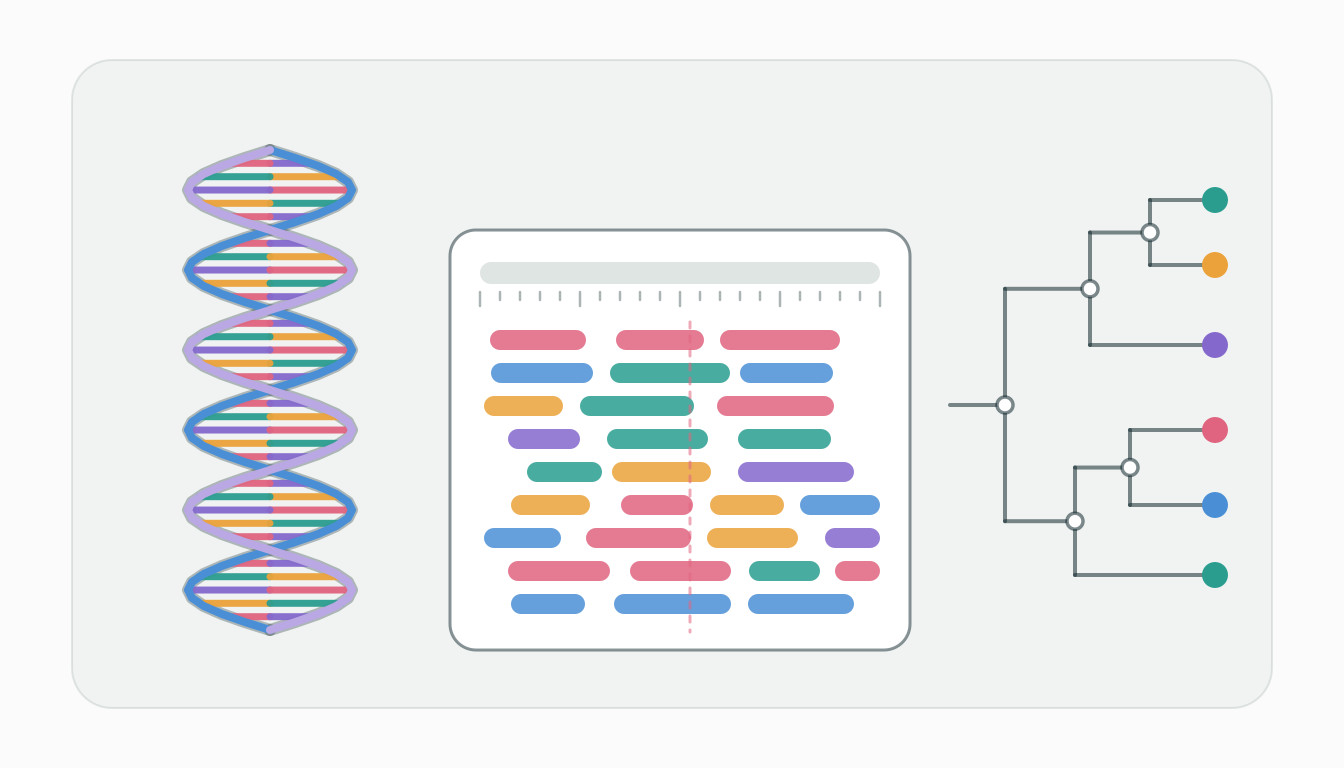
7 modules. Read each lesson, work the examples, then take the module quiz.
What this course covers, how to study it, and the habits that keep a genomic result honest.
Genome size and how it is measured, repeats and transposable elements, polyploidy and subgenomes, and the organelle DNA and heterozygosity that shape every plant sequencing project.
What sequencing technologies produce, how much data a genome needs, how FASTQ files and Phred scores describe confidence, and how to inspect and trim reads.
K-mers and what they reveal about a genome, how assemblers join reads and where repeats and heterozygosity defeat them, and how to judge an assembly by contiguity, completeness and accuracy.
How reads are aligned and recorded in SAM files, how variants and genotypes are called from read counts, how to filter calls with plant-specific pitfalls in mind, and how allele frequencies and Hardy-Weinberg proportions describe a population.
How genes are predicted and recorded in GFF3, how orthologs, synteny and Ks relate genomes and date duplications, how a distance tree is built and judged, and how functions are transferred and tested for enrichment.
Designing and counting an RNA-seq experiment, normalising with TPM and size factors, testing for differential expression, controlling the false discovery rate, handling file formats and data sharing, and keeping an analysis reproducible.
A summary of the course formulas and checks, an integrated planning example, and a comprehensive final quiz.
A diagram in every lesson and a quick check with an explanation
Worked examples: coverage, flow cytometry, LTR dating, Phred and expected errors, k-mer counting, N50 and BUSCO, CIGAR and FLAG decoding, genotype likelihoods, Hardy-Weinberg, hypergeometric enrichment, TPM, median-of-ratios, Benjamini-Hochberg
Module quizzes with an explanation for every answer and a 25-question final assessment
Certificate of completion with a public verification page
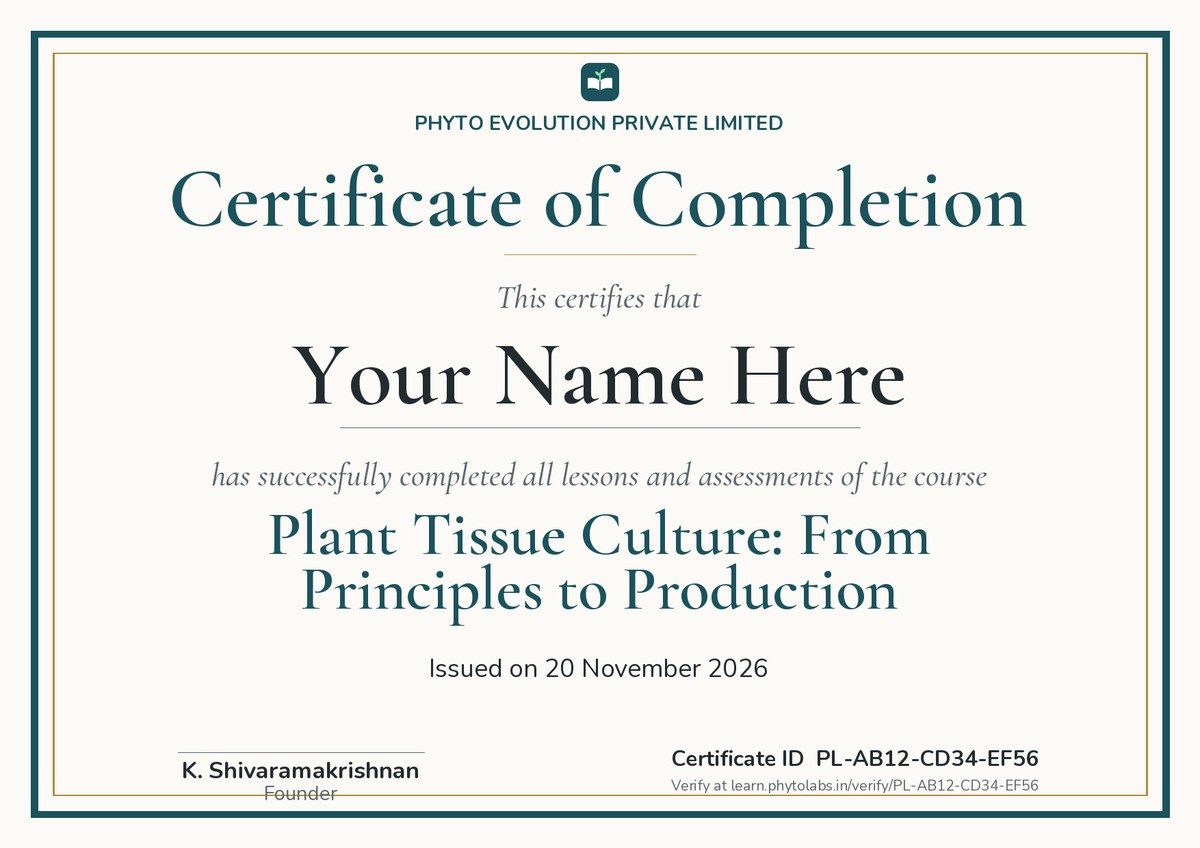
Complete every lesson and pass every quiz in Genomics and Bioinformatics for Plant Scientists. Your certificate has a unique ID and a public verification page.
Start learning freeNo. The ideas and calculations come first and every worked example can be done with a pencil and calculator. A few short command-line lines are shown only to make a step concrete.
MOL-201 (laboratory methods) and an idea of basic statistics help most. PBIO-301 has a short bioinformatics overview that this course builds on and does not repeat.
No. Tools are named as examples of a method, never as recommendations. Methods and their assumptions outlast any program version.
Each worked example uses a small data set with the arithmetic shown, so you can reproduce it and then use the same logic on real data.
Yes. Lessons, quizzes and the certificate are free; a free account opens them and saves progress.
Finish every lesson and pass every module quiz and the final assessment (70% or more, unlimited retries).
Free, self-paced, with quizzes, calculators and a certificate.