Module 1
The Physical Framework
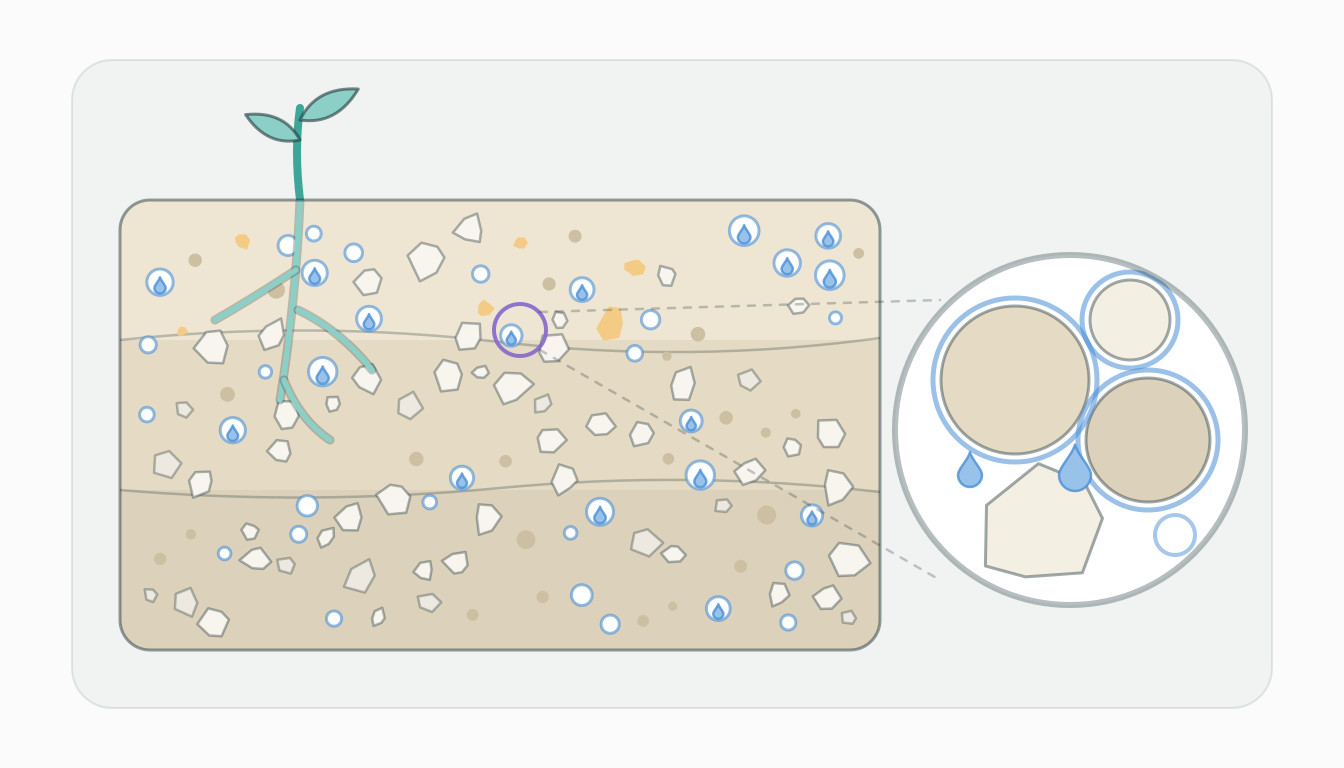
Soil and substrate as a three-phase system of solids, water and air, and the measurements that describe it: density, porosity, water content, texture, structure and pore size.
Part of Protected Cultivation PathwayThe Complete Plant Science Library
Soils and growing media as three-phase physical, chemical and biological systems: density and porosity, texture and structure, water retention and air-filled space in containers, pH, buffering, cation exchange and salinity, organic matter and nitrogen, nutrient transport, the root-zone biology, and how to design, mix, test and interpret a substrate, all worked through with real numbers.
8 modules. Read each lesson, work the examples, then take the module quiz.
Soil and substrate as a three-phase system of solids, water and air, and the measurements that describe it: density, porosity, water content, texture, structure and pore size.
How pores hold water against suction, how retention curves are read, why container height decides air-filled porosity, and how water availability and conductivity behave as a medium dries.
pH and what controls it, cation exchange capacity and base saturation, buffering and the concept of lime requirement, and electrical conductivity, salinity and leaching.
What organic materials are made of, how the carbon to nitrogen ratio controls decomposition and nitrogen immobilisation, and how decomposition changes structure and stability over a crop cycle.
How nutrients are stored and reach the root, the transformations of nitrogen, phosphorus and other elements, the biology of the rhizosphere, and why oxygen supply and redox condition decide so much.
The physical and chemical properties of the main classes of substrate component, how to calculate the properties of a mix by volume, and how to match a mix to a container and a purpose.
How to sample and test a substrate or soil, what physical and chemical test results mean and what they do not, and how to read a laboratory report against symptoms in the crop.
A summary of the course as one system, with the key formulas and an integrated worked example, followed by a comprehensive final quiz.
A diagram in every lesson, drawn from the same formulas the lessons use
Worked examples with real numbers: porosity, water content, retention curves, container air space, CEC and base saturation, lime requirement, leaching fraction, C:N and nitrogen immobilisation, mass flow and diffusion, mixing by volume, extracts and sampling error
Quick checks in every lesson and ten-question module quizzes with an explanation for every answer
A 25-question final assessment and a certificate of completion with a public verification page
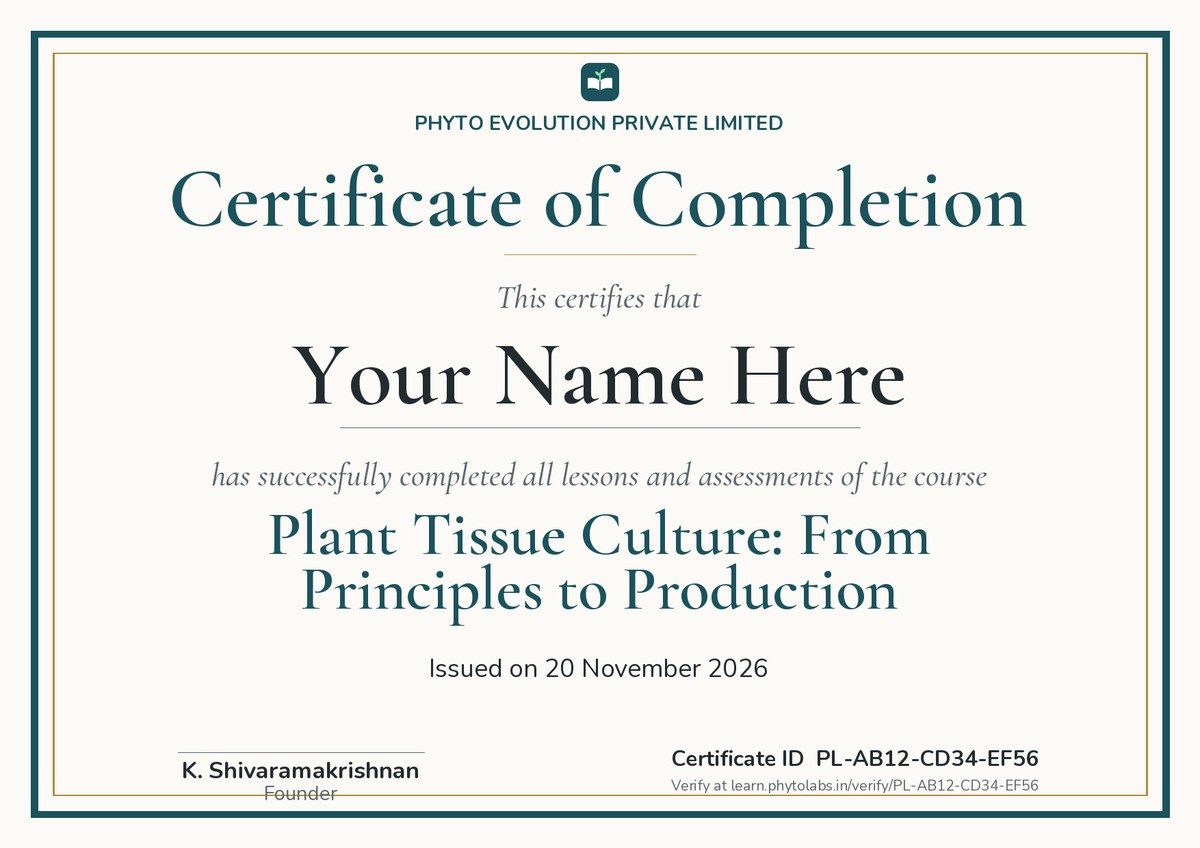
Complete every lesson and pass every quiz in Substrate and Soil Science. Your certificate has a unique ID and a public verification page.
Start learning freeNo. It explains properties, calculations and how to test them. Materials are described by their physical and chemical behaviour, never by brand.
Arithmetic, a calculator and the idea of a logarithm. Every calculation is worked through step by step with real numbers.
No. Mineral soils and soilless substrates are treated side by side, and the differences between them are explained from the same principles.
WIS-201 and PNM-201 pair well with this course, but neither is required.
The three substrates are illustrative, defined by stated van Genuchten parameters so that every number can be reproduced. The soil values are typical published ones. Always measure your own material.
Finish every lesson and pass every module quiz and the final assessment (70% or more, unlimited retries).
Free, self-paced, with quizzes, calculators and a certificate.