Module 1
What a Quality System Is For
Why laboratories need a quality system, how plan-do-check-act and standards thinking work at principle level, and how controls, blanks, reference materials and traceability make a result checkable.
Part of Tissue Culture Specialist PathwayThe Complete Plant Science Library
The science behind trustworthy laboratory results and safe laboratory work: quality-system thinking, SOPs and data integrity, calibration and measurement uncertainty, method validation (accuracy, precision, LOD, LOQ, linearity), control charts and multi-rules, risk assessment, biosafety levels, decontamination, waste and spills, incidents, audits and corrective action, with every calculation worked through.

8 modules. Read each lesson, work the examples, then take the module quiz.
Why laboratories need a quality system, how plan-do-check-act and standards thinking work at principle level, and how controls, blanks, reference materials and traceability make a result checkable.
How standard operating procedures and document control work, what makes a record trustworthy (ALCOA+), and how sample identity, labelling and stability are kept intact from collection to disposal.
Error, bias and precision with mean, SD and CV; checking and calibrating equipment; fitting and using a calibration curve; and combining sources of uncertainty into a stated result.
How to prove a method is fit for its purpose: validation versus verification, trueness and precision, detection and quantification limits, linearity and range, and robustness.
Control charts and how their limits are calculated, multi-rule decisions and their false-alarm costs, proficiency testing and z-scores, and sampling and acceptance plans.
Hazard and risk, risk assessment and the hierarchy of controls; biosafety levels and containment equipment; decontamination, D-values and chemical disinfection; and waste streams and spill response.
How to handle and learn from incidents and near misses, how internal audits sample evidence, and how root-cause analysis and corrective and preventive action turn findings into lasting change.
A comprehensive final quiz across all seven modules.
At least one original diagram in every lesson
Worked examples with real numbers: tolerance and CV, pipette check, calibration curve, uncertainty budget, spike recovery, LOD and LOQ, control-chart limits, z-scores, operating characteristic curve, D-value, incident rate
Module quizzes of 10 questions and a 25-question final assessment, with an explanation for every answer
Certificate of completion with a public verification page
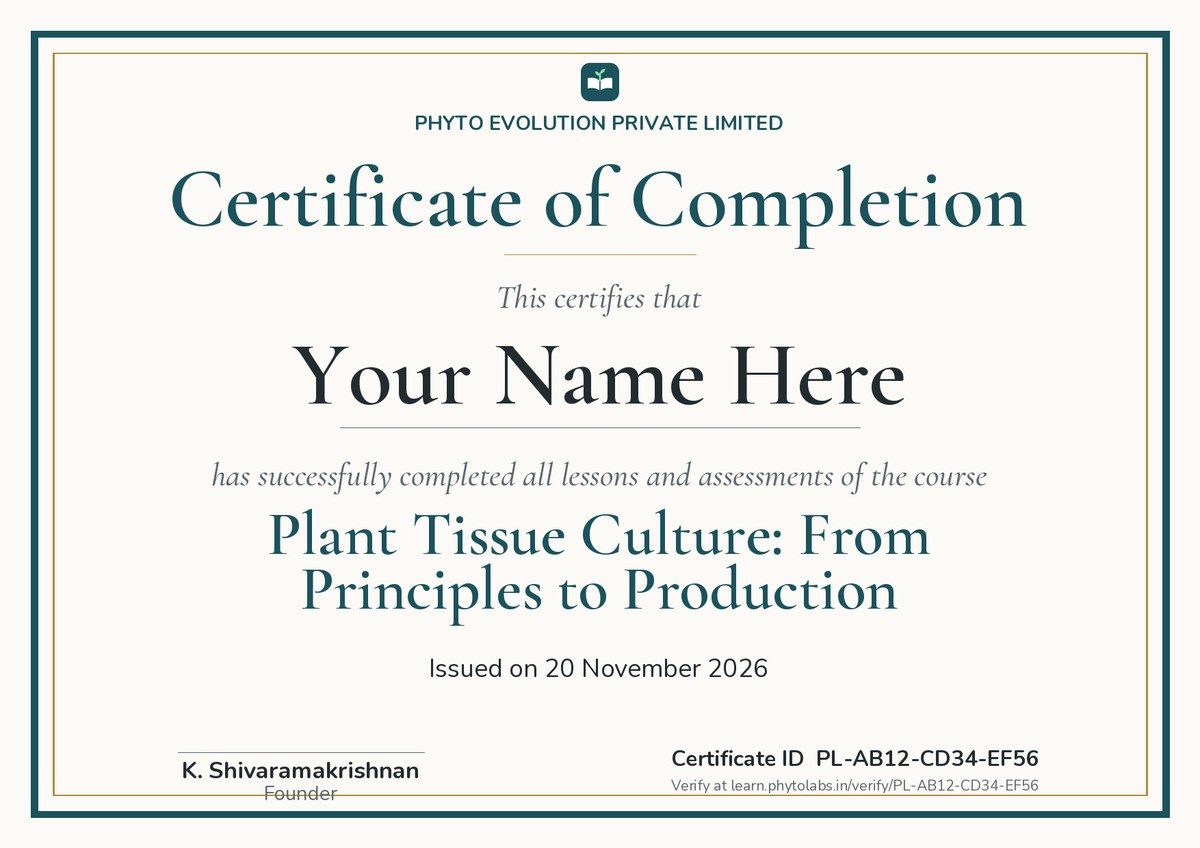
Complete every lesson and pass every quiz in Quality, Biosafety and Good Laboratory Practice. Your certificate has a unique ID and a public verification page.
Start learning freeNo. It teaches the science and reasoning behind laboratory quality and safety, not costing, consulting or business planning.
No. It explains the principles that standards share. The Phyto Learn Academy certificate shows you completed the course.
Your institution's biosafety committee and current national regulations decide. The course teaches how to reason about risk; it does not replace your local requirements.
Arithmetic and a calculator. Every calculation (mean, SD, CV, control limits, calibration line, uncertainty budget, LOD, sampling plans) is set out step by step.
Yes. Lessons, quizzes and the certificate are free; a free account opens them and saves progress.
Finish every lesson and pass every module quiz and the final assessment (70% or more, unlimited retries).
Free, self-paced, with quizzes, calculators and a certificate.