Module 1
Foundations of Hormone Action
What a plant hormone is, how to handle hormone concentrations and dilutions correctly, how to read a dose-response curve, and the signalling logic shared by all hormone pathways.
Part of Plant Science FoundationsTissue Culture Specialist PathwayThe Complete Plant Science Library
How plant hormones are made, moved, sensed and switched off: auxin, cytokinin, gibberellin, abscisic acid, ethylene, brassinosteroids, jasmonates, salicylic acid, strigolactones and peptide signals, with the calculations (molar and mass concentrations, dilutions, ratios, dose-response curves) and the crosstalk logic that let you reason about culture, greenhouse and field responses.
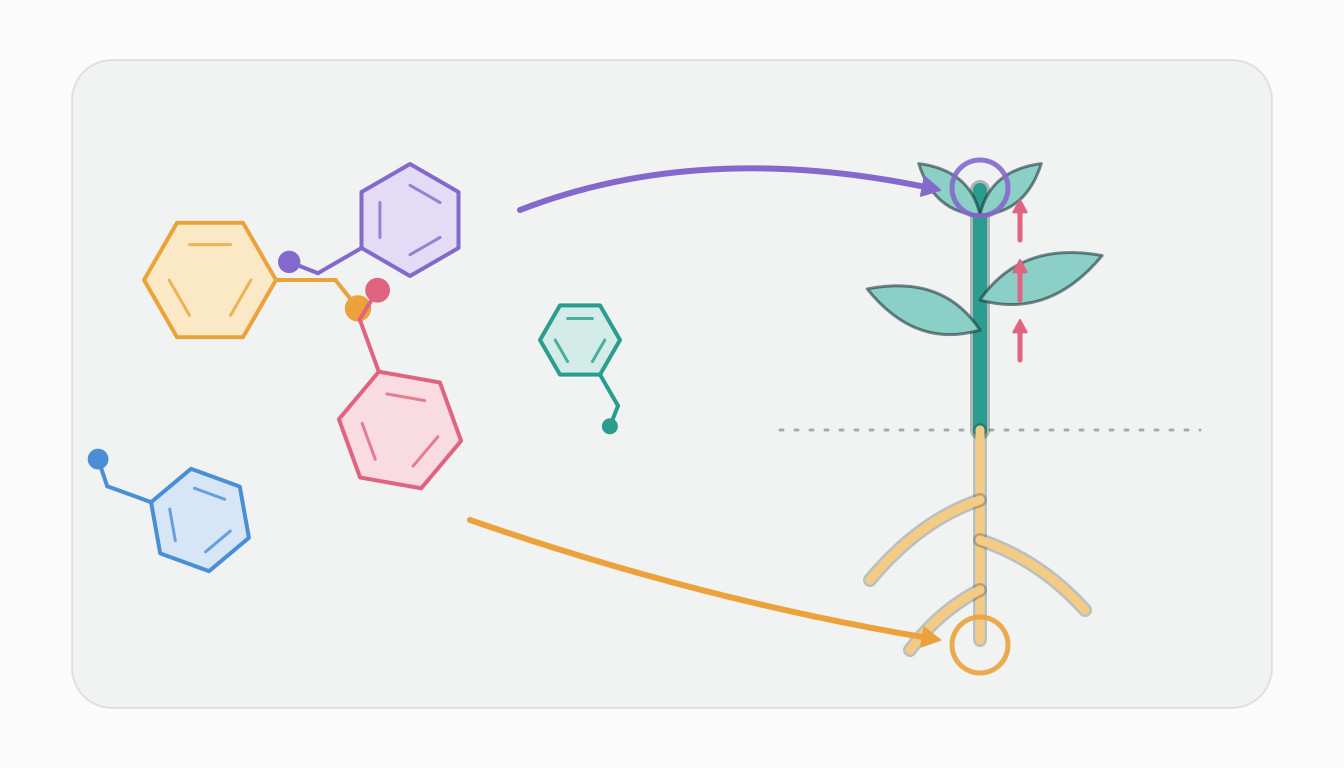
8 modules. Read each lesson, work the examples, then take the module quiz.
What a plant hormone is, how to handle hormone concentrations and dilutions correctly, how to read a dose-response curve, and the signalling logic shared by all hormone pathways.
How auxin is made and removed, why it moves in one direction, how the TIR1/AFB-Aux/IAA-ARF system senses it, and what auxin does in roots, shoots and tropisms.
The chemistry, synthesis and removal of cytokinin, its two-component signalling system, and how the auxin:cytokinin ratio steers regeneration, with the calculations needed to use the ratio correctly.
Gibberellin synthesis and the GID1-DELLA switch, abscisic acid synthesis and the PYR/PYL-PP2C-SnRK2 core, and how the two hormones balance each other in seeds and under stress.
Ethylene as a gas hormone, its synthesis and the Yang cycle, its receptor and signalling chain, its role in ripening and in closed vessels, and the brassinosteroid kinase relay.
Jasmonates and salicylic acid in defence, strigolactones in branching and the rhizosphere, and the peptide hormones that signal through receptor kinases at the cell surface.
How hormone pathways interact, three worked case studies of hormone interaction in plants, and the principles that govern the use of growth regulators in culture and in horticulture.
A comprehensive final quiz across all seven modules.
An original diagram in every lesson, with the signalling pathways drawn step by step
Worked examples with real numbers: mg/L to micromolar, stock dilutions, auxin:cytokinin ratios, dose-response readings, headspace gas, pH and ion trapping
At least one quick check in every lesson and an explained answer for every quiz question
Module quizzes of 10 questions and a 25-question final assessment
Verified references in every lesson
Certificate of completion with a public verification page
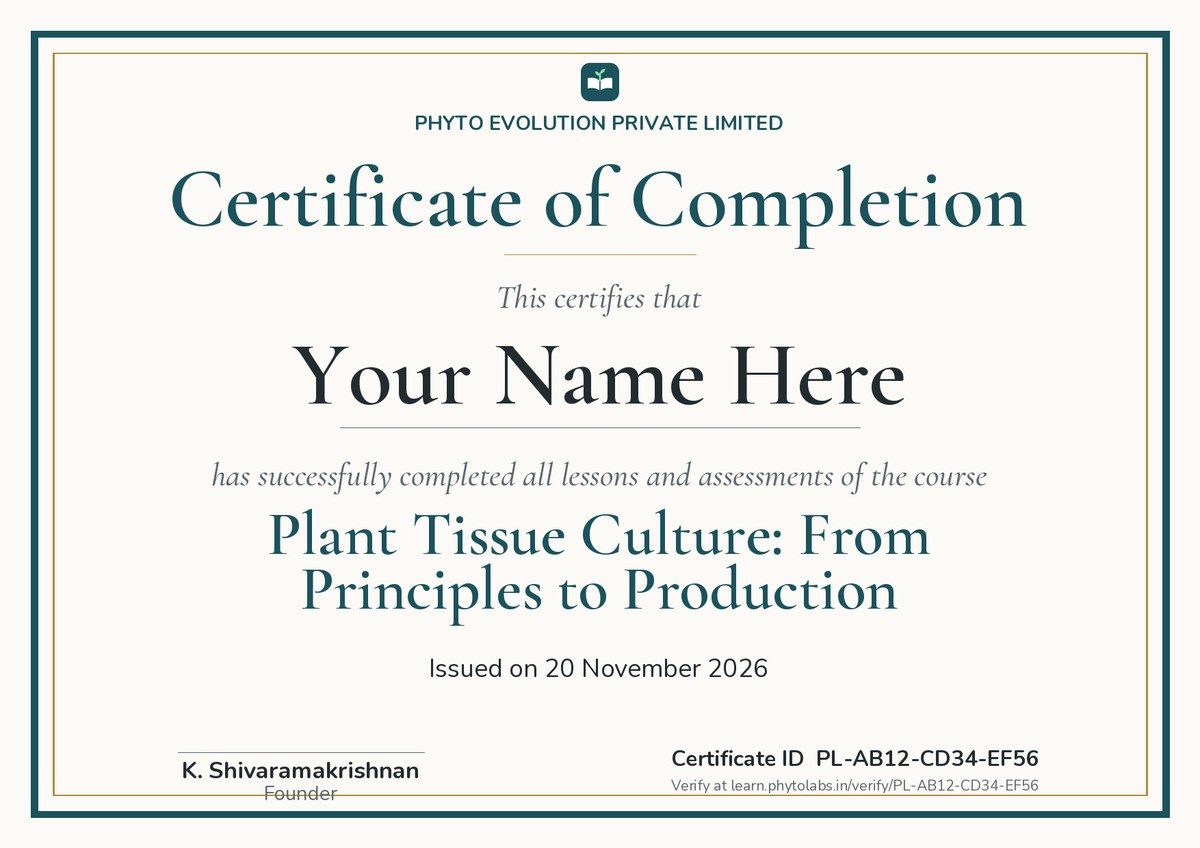
Complete every lesson and pass every quiz in Plant Growth Regulators and Hormone Signalling. Your certificate has a unique ID and a public verification page.
Start learning freeNo. It teaches the biology and the arithmetic so that you can reason about any recipe, not a list of recipes. It names no products and gives no commercial protocols.
PTC-101 uses growth regulators in culture; this course explains how they work, so you can interpret what you see.
Only secondary-school chemistry for moles and concentrations. Every signalling pathway is drawn and explained step by step, and every calculation is worked through.
The pathways described are the well-supported core models from model species such as Arabidopsis, rice and tomato. Where roles are still debated the lesson says so, and species vary.
Yes. Lessons, quizzes and the certificate are free; a free account opens them and saves progress.
Finish every lesson and pass every module quiz and the final assessment (70% or more, unlimited retries).
Free, self-paced, with quizzes, calculators and a certificate.